
If you’ve ever found yourself in front of the class thinking, “Wait… what comes next?” — you’re not alone. In fact, the biggest fear for most yoga teachers is the worry that they’ll forget all or part of their sequence during class. The reality is – it happens to all of us from time to time. This post explores strategic techniques for remembering your yoga sequence – with confidence, clarity and creativity. Worry less and focus more on holding space for your students.
Why Remembering Matters
You put a lot of time and effort into creating your sequence. Whether you’re building to a peak pose, focusing on a physical area of the body, or getting into all the nooks and crannies for a well-rounded overall practice, we plan our sequence to flow seamlessly from one asana to another. Yoga is more about how it feels than how it looks, and a carefully crafted sequence assists students in feeling that mind-body connection.
Without the seamless flow, our movements can become disjointed. We can break that mind-body connection which can lead to an unfulfilling class – for both you and your students. And when you’re not thinking about “what comes next,” you can be fully present with your students!
Make no mistake – distractions happen. Even the most seasoned teachers forget parts of their sequence from time to time. The good news? Sequence recall is a skill that can be strengthened with intention and practice.
How Memory Works in the Context of Teaching Yoga
-
- Encoding – Building and learning the sequence yourself. Perhaps writing the sequence out.
-
- Storage – Internalizing the sequence by visualizing the poses and practicing it physically in your own body with repetition.
-
- Retrieval – recalling the sequence in your mind while teaching.
Six Strategies for Remembering Your Sequence that Work
1. Name your sequence – You can name your sequence something that has to do with the physical part of the asana practice (i.e., Yoga for Hip Opening, Twisting Detox) or the theme of the class. Read How to Theme a Yoga Class
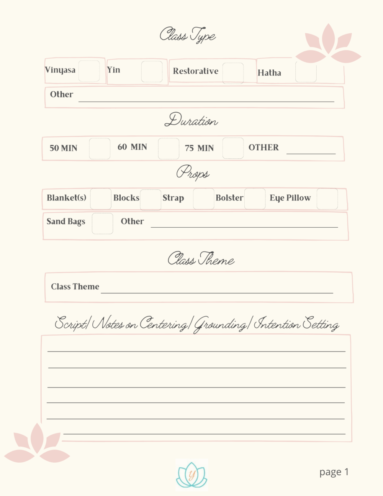
2. Write it down* – This may not be for everyone, but new teachers especially can benefit from writing out your sequence. Yoga Teacher Journey’s Class Planning Template can help document your sequence in an organized fashion! I used to write (type) all my sequences to help me remember and then bring them with me to class. At some point, I stopped looking at them while teaching and they became a distraction. That’s when I stopped writing them out and memorized them -for the most part.
*Some teachers prefer drawing pose stick figures in sequence. Drawing these did not come easy to me so I abandoned that idea early on – but it might work for you!
3. Chunk it out – What is your starting pose? Will you incorporate breathwork? Asking yourself these questions is just the beginning of chunking your sequence. You can break it into logical segments that make sense to you such as:
-
- Beginning Posture
-
- Grounding and Centering
-
- Breathwork
-
- Warm-up
-
- Sun Salutations
-
- Standing Sequence
-
- Standing Balancing Postures
-
- Backbends
-
- Cool-down
-
- Savasana
4. Physically practice the sequence – Moving kinesthetically on your own mat will embed the postures and transitions in muscle memory. Practice at least once or twice to solidify the flow.
5. Say it out loud – either teach it to someone else or to yourself. You can even record yourself and play it back following your own cues. This can help you understand if you’re cueing effectively too.
6. Visualize the flow –after doing all of the above, it might still be beneficial to use visualization techniques to walk through your flow. I do this sometimes driving to class or even the night before as I’m lying in bed. I picture each pose and transition of the class from start to finish.
Recall Your Sequence While Teaching
Before we begin talking about strategies for recalling your sequence while teaching, I’d like to preface this with an important note: You don’t have to recall all of your sequence!! REALLY!! In all honesty, who will know? You are the only one who will know – unless of course you give it away.
Your yoga class is not about you. It is about the students. They are not worrying about if you remember and teach your sequence exactly how you planned it. They are there for yoga. To re-center themselves. For connection. For a pause in their day. For many other reasons. Not for your perfectly remembered sequence. Period.
With that said, I know it’s important to us to remember the beautiful sequence we so carefully designed for our class.
If you find yourself in the position of drawing a blank, take a pause. You can bring students to child’s pose (Balasana) or downward facing dog (Adho Mukha Svanasana), if appropriate. Or, keep them in the posture they happen to be in to give yourself time to pause, take a deep breath and recall where you’re going next.

If you have your written sequence with you. Take time to find where you are, see what’s next, and take it from there. The “chunking” from earlier should help you locate where you are and recall the next chunk.
As I said early on in this post, we want the sequence to flow smoothly for the best possible experience for our students. For this reason, it is helpful to have a default sequence you can pull from in the event you do forget all or part of your planned sequence.
We should all have a default sequence anyway in case of an emergency, an unexpected event, or just an overly busy week with no time to plan something new. When you forget, it is time to draw from that sequence.
Craft a Signature Sequence
We all like to design fresh new flows. New flows allow us to change it up for our students and for ourselves giving us a new perspective. But realistically, you could teach the same flow week after week and it would be fine. There’s actually something to be said for redundancy. Students can learn the flow and practice it without worrying about what comes next. Like a sun salutation (Surya Namaskar), we can do it without thinking and there’s comfort in knowing the flow.
Therefore, if you haven’t already, craft yourself a go-to signature sequence. One you can pull out of your pocket – so to speak – at anytime and teach. Then learn that flow really, really, well. Write it, speak it, practice it in your body until you can flow through it without thinking. It will be less stressful knowing you have it and can use any part of it at anytime.
Remember the Sequence but Accidentally Skip a Pose?
If you remember your sequence but accidentally skip a pose on your second side, there are a few things you can do:
If you haven’t gone too far past the pose and can easily flow back to that posture, perhaps acknowledge “we skipped it” and take them back to that pose, then proceed from there.
If you can seamlessly add it back into the flow without mentioning it – do that. For example, your sequence called for extended triangle pose (Utthita Trikonasana) before extended side angle (Utthita Parsvakonasana) but you skipped it, slide it in after the side angle pose – no big deal!
If you’ve flowed through an entire side and remember you skipped something on the other side:
Let it go if you can and move on. If it’s an important component of something you’re building up to, you can take students back to that pose independently of the other postures. Acknowledge “we skipped it” and take them to the posture.
Authenticity goes a long way. We are all human, and it happens. Don’t be too hard on yourself and move on.
Final Thoughts: Trust Yourself and Your Practice
The most effective tool in your toolkit is self-confidence. As you grow as a teacher, your intuition will become a stronger guide. Allow your class to be a living dialogue between you and your students; let the sequence be a framework, not a cage. The true art of teaching yoga lies not in perfect memory, but in the courage to show up, be present, and adapt!
If you walk into your next class and forget what comes next, remember: you are not alone, and you are more than your sequence. Your presence, your kindness, and your authenticity are what your students will remember most.
Read next:
7 Strategies to Becoming an Authentic Yoga Teacher